Best AI & Machine Learning Courses with Placement in India (2026 Guide)
📌 Essential Placement Insights for 2026:
- With thousands of edtech platforms advertising "100% placement guarantees," learners must evaluate the legal and structural reality behind commercial claims.
- Beware of restrictive "Pay After Placement" (PAP) contracts featuring multi-year Income Share Agreements (ISAs) with high salary deduction percentages.
- The most reliable, transparent pathway to full-time placement is an enforceable Guaranteed 6-Month Paid Corporate Internship backed by a competitive monthly stipend.
- Multinational employers and Global Capability Centers (GCCs) actively prioritize candidates holding independently verifiable digital credentials from IBM SkillsBuild and Microsoft Learn.
The artificial intelligence and machine learning job market across India's leading technology corridors—including Bengaluru, Hyderabad, Pune, Gurugram, and Noida—is experiencing an unprecedented paradox. While enterprises report thousands of unfilled openings for AI Engineers, Data Scientists, and Machine Learning Specialists, thousands of certified college graduates remain unplaced.
This disconnect has led to a surge in searches for the best ai courses in india with placement. Prospective students and working IT professionals seeking to transition into AI frequently confront difficult questions: What does "placement assistance" actually mean versus a legitimate corporate hiring pipeline? How do "Pay After Placement" agreements compare to corporate apprenticeships? And what hiring models provide real career security without long-term legal entanglements?
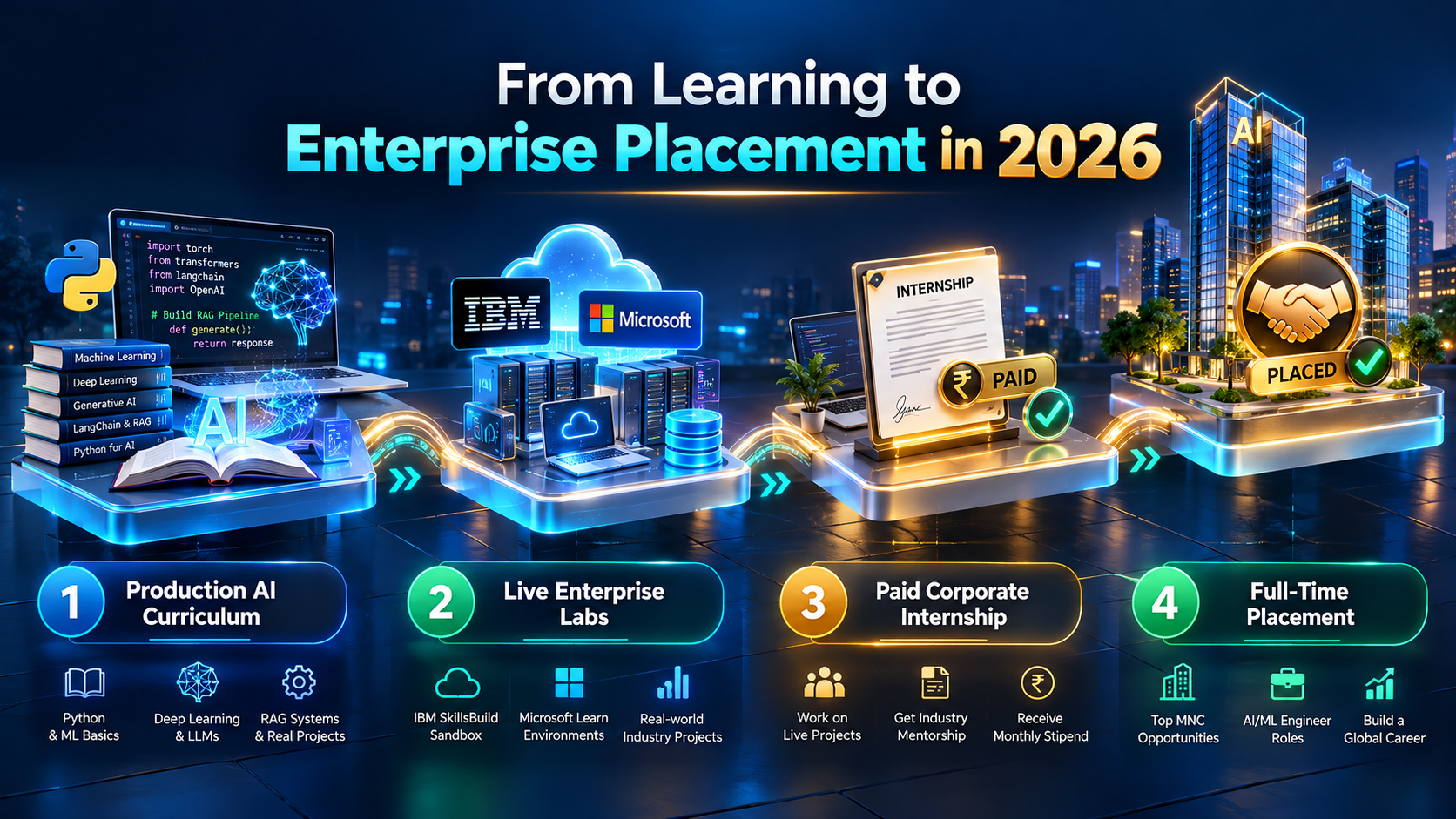
In this complete 2026 guide, we deconstruct the operational mechanisms of technical placement programs, compare commercial training models, and explain how AI Campus has established an industry-first standard by pairing dual global accreditations with an enforceable Guaranteed 6-Month Paid Corporate Internship.
Deconstructing "Placement Assistance" vs. Real Hiring Networks
Before enrolling in any career program or paying course fees, students must scrutinize how the institute defines career support:
- Generic Link Forwarding: Many institutes satisfy their "placement assistance" clause simply by emailing students publicly available job links from LinkedIn, Naukri, or Indeed.
- Strict Elimination Clauses: Certain "placement guarantee" bootcamps enforce unrealistic attendance (e.g., 98%) or test score criteria designed to disqualify the majority of students from placement claims before graduation.
- Unpaid Observation Gigs: Some programs place graduates into unpaid "shadowing" roles that involve zero coding responsibility and fail to convert into full-time employment.
Pay After Placement (PAP) vs. Guaranteed Paid Corporate Internship
Understanding the economic contrast between Pay After Placement (Income Share Agreements) and a transparent corporate apprenticeship is critical for your financial future:
| Comparison Parameter | Pay After Placement (ISA Models) | AI Campus Corporate Model |
|---|---|---|
| Financial Commitment | 15% to 20% of your gross monthly salary deducted for up to 36 months via legal NBFC contracts. | Fixed, transparent fee with flexible zero-cost EMI plans and zero post-placement deductions. |
| Internship Structure | Theoretical mock capstone projects; zero verified corporate tenure. | Guaranteed 6-Month Paid Corporate Internship with competitive monthly stipend. |
| Industry Credentials | Platform-specific internal course completion certificate. | Verifiable digital badges from IBM SkillsBuild & Microsoft Learn candidate credentials. |
| Job Flexibility | Forced to accept any qualifying job offer or face severe financial penalty clauses. | Freedom to select optimal career offers with full ownership of your earnings from day one. |
The 4 Pillars of True AI & Machine Learning Placement Readiness
Corporate engineering teams evaluate candidates through rigorous multi-stage technical assessments. A placement-ready program must build competencies across four operational pillars:
1. Production-Grade Algorithmic Systems
Moving past toy datasets to enterprise architectures:
- Advanced Python vectorization (NumPy, Pandas) and high-throughput SQL database querying.
- Classical Machine Learning: Gradient boosting algorithms (XGBoost, LightGBM, CatBoost) with rigorous cross-validation.
- Deep Learning in PyTorch: Convolutional neural networks, transfer learning, and sequence-to-sequence transformers.
2. Generative AI, LLMs & RAG Pipelines
Mastering the highest-demand technical skill of 2026:
- Retrieval-Augmented Generation (RAG) using vector databases (Pinecone, ChromaDB) and LangChain orchestration.
- Parameter-Efficient Fine-Tuning (PEFT/LoRA) and model quantization for low-latency edge deployment.
- Building autonomous AI agent architectures and deploying structured validation guardrails.
3. Multi-Cloud MLOps & Docker Containerization
Deploying models into enterprise cloud environments:
- Exposing high-throughput inference endpoints using asynchronous FastAPI frameworks.
- Packaging dependencies and models into portable, immutable Docker containers.
- Deploying and monitoring model drift on enterprise cloud infrastructures (AWS and Microsoft Azure).
4. Rigorous Mock Technical Rounds & Soft Skills
Preparing candidates for executive technical interviews:
- 1-on-1 coding mock rounds with senior industry data scientists and machine learning engineers.
- System design interview preparation: Explaining end-to-end architecture trade-offs using the STAR method.
- ATS-optimized resume engineering and LinkedIn profile optimization with verified Credly badges.
Global Vendor Validation: IBM SkillsBuild & Microsoft Learn
Third-party vendor validation gives candidates an undeniable edge over generic bootcamp applicants. At AI Campus, training is anchored in official global partnerships:
🌐 Official IBM SkillsBuild Credentials
Through IBM Learning at AI Campus, learners earn cryptographically verifiable digital badges on Credly across Data Science, AI Foundations, and Big Data that recruiters verify with one click.
☁️ Microsoft Azure Certified Pathways
Through Microsoft Learn access, students train inside live Azure cloud sandboxes, mastering Azure OpenAI Service and preparing for Microsoft certified AI and Data Scientist credentials.
The Decisive Game-Changer: Guaranteed 6-Month Paid Corporate Internship
While completing coursework builds technical readiness, corporate employers hire based on proven production experience. The definitive highlight of the AI Campus Placement Model is an enforceable Guaranteed 6-Month Paid Corporate Internship.
- Guaranteed Corporate Allocation: Students who complete the 6-month instructor-led curriculum and pass standard benchmark evaluations are allocated directly into partner corporate technology teams.
- Competitive Monthly Stipend: Throughout the 6 months of corporate tenure, every intern receives a guaranteed, competitive monthly stipend paid directly into their personal bank account.
- Real Client Deployments: Interns do not work on simulated demo spreadsheets; they handle active commercial codebase branches, optimize inference latency, and resolve live bugs.
- Direct Conversion to PPOs: Corporate partner firms regularly evaluate interns during their tenure and convert high performers into permanent full-time AI & ML Engineers.
Frequently Asked Questions (FAQs)
1. What is the difference between placement assistance and a placement guarantee?
Placement assistance typically involves sharing job portal links and resume reviews. A true placement program like AI Campus combines structured training with guaranteed corporate partner allocations and an enforceable 6-month paid corporate internship.
2. Does AI Campus use Pay After Placement (ISA) contracts?
No. AI Campus rejects restrictive Income Share Agreements (ISAs) that deduct percentages from your monthly paycheck for years. Training is provided under transparent, all-inclusive pricing with flexible zero-cost EMI plans, leaving 100% of your salary in your pocket.
3. Is the corporate internship legally guaranteed with a monthly stipend?
Yes. Enrolled learners who complete the instructor-led coursework and meet benchmark evaluations receive a guaranteed 6-month corporate internship supported by a competitive monthly stipend deposited directly to their bank account.
4. Are students from non-computer science disciplines eligible for placement?
Yes. Over 40% of placed learners come from mechanical, civil, electrical, BCA, B.Sc., or commerce backgrounds. Dedicated foundational bridge modules build coding and mathematics proficiencies from the ground up.
Launch Your High-Growth Career with 100% Placement Support
Don't get locked into restrictive ISAs. Master modern AI & Machine Learning, earn official IBM & Microsoft credentials, and launch your career with an enforceable 6-month paid corporate internship.
Explore Placement Records & Apply Now →*Guaranteed monthly stipend corporate internship • Flexible zero-cost EMI plans available
Key Questions & Answers
What is the difference between placement assistance and a placement guarantee?
Placement assistance typically involves sharing job portal links and resume reviews. A true placement program combines structured training with guaranteed corporate partner allocations and an enforceable 6-month paid corporate internship.
Does AI Campus use Pay After Placement (ISA) contracts?
No. AI Campus rejects restrictive Income Share Agreements (ISAs) that deduct percentages from your monthly paycheck for years. Training is provided under transparent, all-inclusive pricing with flexible zero-cost EMI plans.
Is the 6-month corporate internship guaranteed with a monthly stipend?
Yes. Enrolled learners who complete the instructor-led coursework and meet benchmark evaluations receive a guaranteed 6-month corporate internship backed by a competitive monthly stipend deposited directly to their bank account.
Are students from non-computer science disciplines eligible for placement?
Yes. Over 40% of placed learners come from mechanical, civil, electrical, BCA, B.Sc., or commerce backgrounds with foundational bridge modules covering Python and applied math.