Best Generative AI & LLM Course in India (2026): Prompt Engineering, RAG & Paid Internships
📌 Essential Takeaways for Aspiring AI Engineers:
- Generative AI and Large Language Model (LLM) engineering have become the single highest-paying technical specialization across the Indian tech sector in 2026.
- Entry-level engineers must move beyond basic prompt design; corporate engineering teams hire based on Retrieval-Augmented Generation (RAG) architectures, vector indexing, parameter-efficient fine-tuning (LoRA/QLoRA), and autonomous agent frameworks.
- Programs integrated directly with official enterprise portals from IBM SkillsBuild and Microsoft Learn provide verifiable Credly digital badges that bypass automated ATS screening filters.
- Coupling intensive instructor-led training with an enforceable Guaranteed 6-Month Paid Corporate Internship provides candidates with verified commercial work experience and competitive monthly stipends.
The global technology landscape is undergoing its most profound transformation since the dawn of the internet. From automated software synthesis and intelligent document extraction to autonomous customer agents, Generative Artificial Intelligence (GenAI) and Large Language Models (LLMs) have evolved from experimental prototypes into mission-critical enterprise production infrastructure.
Across Indian tech hubs—including Bengaluru, Hyderabad, Pune, and Noida—tier-1 IT services giants, Global Capability Centers (GCCs), and cutting-edge product startups are actively competing for engineers who understand how to build, optimize, and deploy LLM applications. However, aspiring developers face a significant dilemma: Most online courses only teach generic API calls or basic ChatGPT prompting, leaving students completely unprepared for real-world enterprise engineering challenges.
If you are seeking a generative ai course with placement guarantee and verifiable corporate tenure, this comprehensive 2026 guide details the complete technical roadmap, evaluates essential enterprise toolchains, and explains how AI Campus prepares learners through dual global credentials and a Guaranteed 6-Month Paid Corporate Internship.
The Evolution of AI Engineering: Moving Beyond Basic Prompting
In late 2023, the industry saw a surge in "Prompt Engineering" bootcamps that taught users how to craft descriptive text instructions. In 2026, enterprise software engineering demands rigorous full-stack algorithmic systems engineering:
Hiring managers at product firms do not hire candidates who simply paste API keys into Python scripts. They evaluate whether you can build hybrid search indices over vector databases, eliminate hallucinations via structured guardrails, optimize inference latency through model quantization, and fine-tune open-weight open-source LLMs on proprietary datasets.
The Complete 2026 Generative AI & LLM Engineering Curriculum
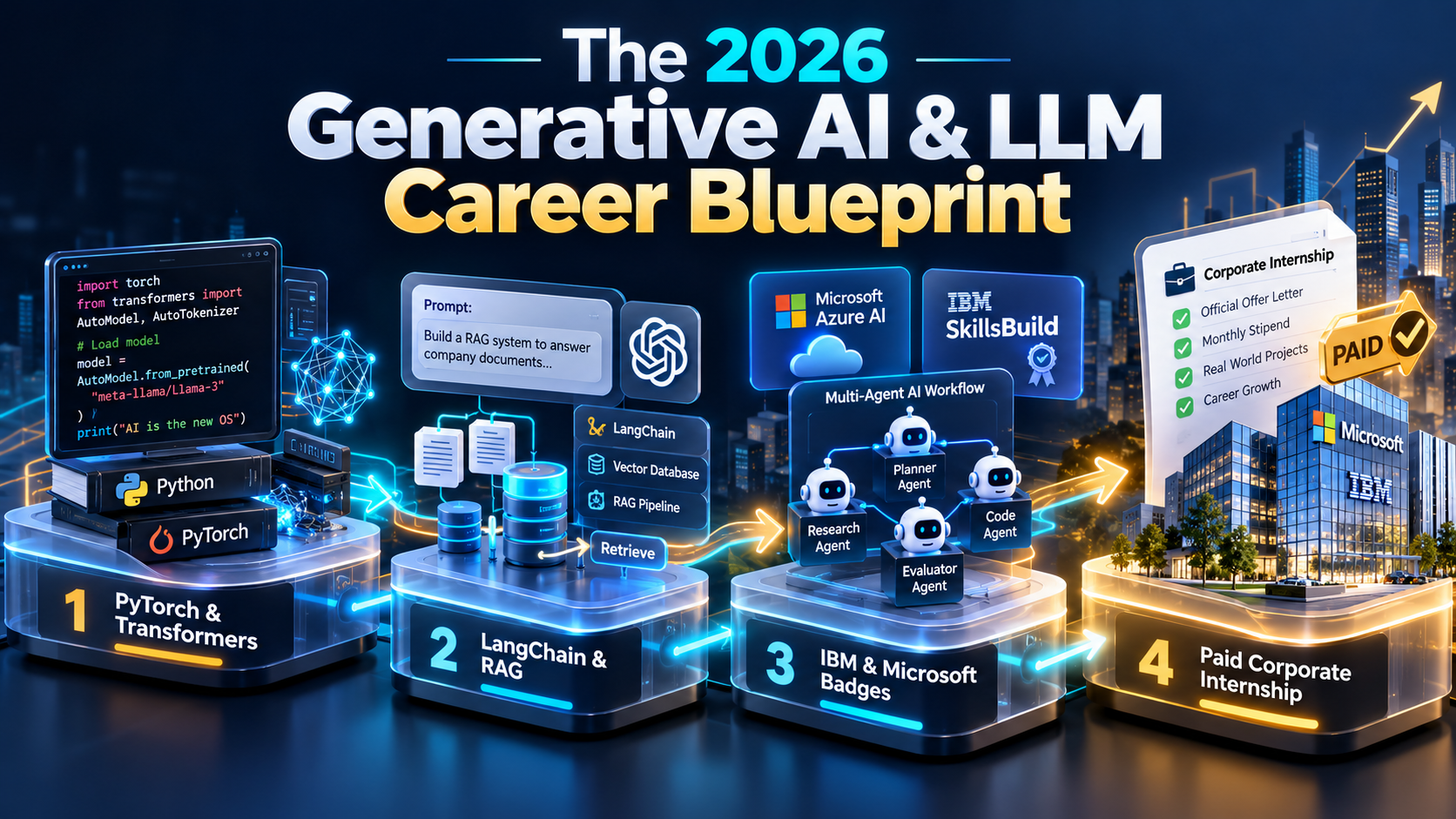
To bridge the academic divide and qualify for high-bracket enterprise engineering roles, learners must master four progressive architectural tiers:
Phase 1: Deep Learning Foundations & Transformer Architecture
Understanding what happens beneath the API abstraction layer:
- Tensor manipulation and automatic differentiation in
PyTorch. - The mathematical mechanics of the Self-Attention and Multi-Head Attention mechanisms.
- Positional encodings, causal masking, and encoder-decoder vs. decoder-only architectures (GPT, Llama, Mistral).
Phase 2: Advanced Retrieval-Augmented Generation (RAG) & Vector Databases
Grounding generative models on private enterprise data stores:
- Semantic document parsing, recursive text splitting, and embedding generation.
- High-performance vector indexing (HNSW graphs) using Pinecone, ChromaDB, and Milvus.
- Hybrid search (combining BM25 keyword matching with dense vector embeddings), contextual compression, and reciprocal rank fusion reranking.
Phase 3: Fine-Tuning, PEFT, LoRA & Quantization
Adapting state-of-the-art foundation models to specialized enterprise domains:
- Parameter-Efficient Fine-Tuning (PEFT) and Low-Rank Adaptation (LoRA/QLoRA) on custom domain datasets.
- Supervised Fine-Tuning (SFT) and Direct Preference Optimization (DPO) for aligned conversational response behavior.
- Model compression: FP16 to INT8/INT4 weight quantization using BitsAndBytes and GGUF formats for efficient edge deployment.
Phase 4: Autonomous Multi-Agent Workflows & Production Serving
Deploying self-healing, agentic workflows with low latency:
- Building multi-agent systems using LangGraph, CrewAI, and AutoGen for complex planning and tool use.
- Serving inference endpoints via high-throughput asynchronous frameworks (FastAPI, vLLM, and TGI).
- Production guardrails, automated hallucination detection, prompt injection mitigation, and token cost tracking.
Global Enterprise Validation: IBM SkillsBuild & Microsoft Learn
A common mistake made by aspiring AI engineers is relying on unverified certificates from private coaching portals. At AI Campus, training is anchored in official vendor partnerships:
🌐 Official IBM SkillsBuild Credentials
Through IBM Learning at AI Campus, learners earn cryptographically verifiable digital badges on Credly in Enterprise AI Foundations, Watson NLP, and Responsible Generative AI.
☁️ Microsoft Azure AI & Applied Skills
Through Microsoft Learn access, students practice inside live Azure cloud sandboxes, mastering Azure OpenAI Service, cognitive search, and preparing for official Microsoft Azure AI certifications.
Comparing Training Formats: Generic Bootcamps vs. Enterprise Apprenticeship
| Curriculum Dimension | Generic Online Courses | AI Campus Generative AI Program |
|---|---|---|
| Technical Depth | Surface-level prompt engineering & API calls | Full-stack RAG, Agentic workflows, LoRA Fine-Tuning & vLLM Serving |
| Cloud Lab Access | Self-hosted local PCs or paid personal accounts | Dedicated GPU sandboxes & Azure OpenAI enterprise tenants provided |
| Corporate Internship | None / Unpaid observation | Guaranteed 6-Month Paid Corporate Internship |
| Monthly Compensation | Zero / Unpaid | Guaranteed Competitive Monthly Stipend |
The Game-Changer: Guaranteed 6-Month Paid Corporate Internship
While mastering algorithms prepares you for technical interviews, corporate hiring panels prioritize candidates who have already built commercial systems. The definitive highlight of the AI Campus program is its enforceable Guaranteed 6-Month Paid Corporate Internship.
- Guaranteed Corporate Allocation: Students who complete the 6-month instructor-led curriculum and clear benchmark evaluations are allocated directly into partner technology teams.
- Competitive Monthly Stipend: Throughout the 6 months of corporate engagement, every intern receives a guaranteed, competitive monthly stipend paid directly into their personal bank account.
- Production Repositories: Interns do not build synthetic mock projects; they work on live client branches, resolve real-time model latency issues, and deploy commercial APIs.
- Direct Conversion to PPOs: Corporate partner enterprises regularly convert high-performing interns into permanent full-time AI engineering roles.
Frequently Asked Questions (FAQs)
1. Can freshers and college students learn Generative AI without an advanced AI background?
Yes. While foundational programming logic in Python is beneficial, comprehensive bridge modules cover foundational linear algebra, neural representations, and machine learning mechanics from the ground up.
2. Are IBM and Microsoft certifications recognized globally by employers?
Yes. Digital credentials earned through official IBM SkillsBuild and Microsoft Learn programs are globally standardized benchmarks, verifiable via Credly and official Microsoft Learn candidate profiles.
3. Is the 6-month corporate internship guaranteed with a monthly stipend?
Yes. Enrolled learners who complete the instructor-led curriculum and pass standard benchmark evaluations receive a guaranteed 6-month corporate internship supported by a competitive monthly stipend.
4. Are zero-cost EMI plans available for students?
Yes. Transparent fee structures with flexible zero-cost EMI options are available through partnered banking institutions, allowing students to pay in manageable monthly installments without financial strain.
Lead the Generative AI Revolution in 2026
Don't get left behind by obsolete coding skills. Master full-stack Generative AI, earn official IBM & Microsoft credentials, and launch your career with an enforceable 6-month paid corporate internship.
Explore Generative AI Program & Apply Now →*Guaranteed monthly stipend corporate internship • Flexible zero-cost EMI plans available
Key Questions & Answers
Can freshers and college students learn Generative AI without an advanced AI background?
Yes. While foundational programming logic in Python is beneficial, comprehensive bridge modules cover foundational linear algebra, neural representations, and machine learning mechanics from the ground up.
Are IBM and Microsoft certifications recognized globally by employers?
Yes. Digital credentials earned through official IBM SkillsBuild and Microsoft Learn programs are globally standardized benchmarks, verifiable via Credly and official Microsoft Learn candidate profiles.
Is the 6-month corporate internship guaranteed with a monthly stipend?
Yes. Enrolled learners who complete the instructor-led curriculum and pass standard benchmark evaluations receive a guaranteed 6-month corporate internship supported by a competitive monthly stipend.