
Top 50 Python for Data Science & Machine Learning Interview Questions (2026 Guide)
📌 The 2026 Python Technical Screening Standard:
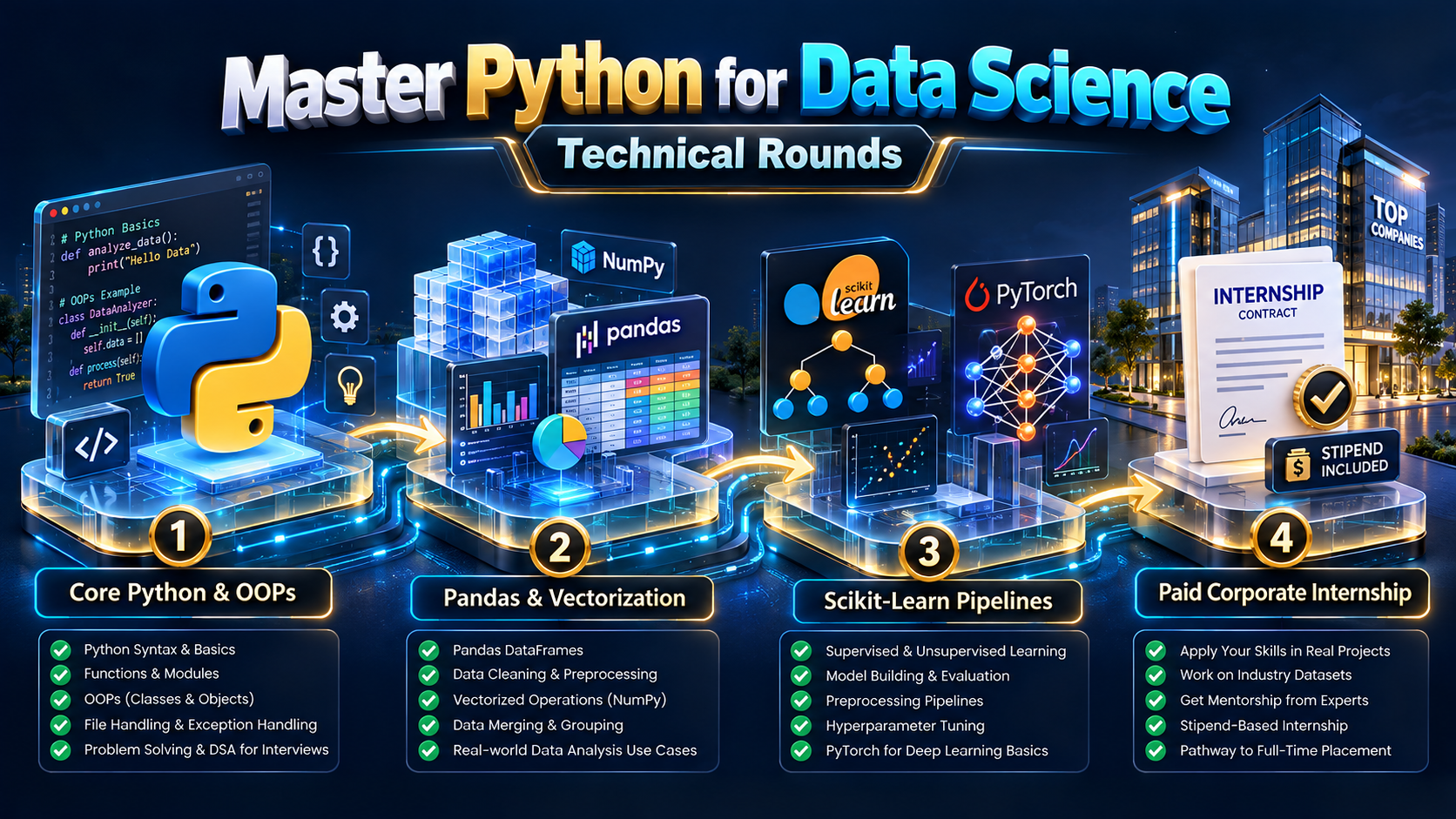
Technical coding evaluations across Indian product companies, Tier-1 IT services, and Global Capability Centers (GCCs) have transformed. Interviewers no longer evaluate whether you know how to write a for loop; they test vectorized computation in NumPy, memory-efficient Pandas transformations, memory management (GIL & GC), OOP design patterns, and clean Scikit-Learn ML pipelines.
Use this categorized 50-question master blueprint to crack the most demanding technical coding rounds in 2026.
If you are an engineering student, analytics fresher, or tech professional preparing for upcoming technical rounds, mastering python for data science interview questions is the single most critical milestone in clearing data science, ML engineering, and data analytics interviews.
Section 1: Core Python Architecture, Memory & OOPs
Q1. What is the fundamental difference between Mutable and Immutable objects in Python?
Immutable objects (integers, floats, strings, tuples, frozensets) cannot have their state modified after creation; any operation produces a new memory object. Mutable objects (lists, dictionaries, sets) can be altered in-place without altering their memory address (id()). In data processing, passing mutable objects as default function arguments can lead to silent bug accumulation.
Q2. Explain the operational difference between __new__ and __init__ in Python.
__new__ is the actual object creator—a static method that returns a new instance of the class in memory. __init__ is the initializer method called after the instance is created to set attributes. In advanced ML engineering, __new__ is overridden when creating Singleton design patterns for global model inference handlers or sub-classing immutable types.
Q3. How do Python Generators conserve memory when streaming multi-gigabyte datasets?
Generators use the yield keyword instead of return. Rather than constructing an entire array in RAM, generators return a lazy evaluation iterator, yielding elements one at a time on demand. This allows data engineers to iterate over multi-gigabyte log files without exhausting system memory.
Q4. What is a Python Decorator, and how is it used in production ML pipelines?
A decorator is a higher-order function that takes another function as an argument and extends its behavior without modifying its source code. In production ML, decorators are used for execution timing, input schema validation, request authentication, and caching model predictions.
Q5. What is the Global Interpreter Lock (GIL), and how do you bypass it for parallel processing?
The GIL is a mutex lock that prevents multiple native threads from executing Python bytecodes simultaneously. For CPU-bound data science tasks, the GIL is bypassed using the multiprocessing module (which spawns independent processes with separate memory spaces) or by offloading computations to C-based libraries like NumPy and PyTorch.
Q6. Differentiate between shallow copy and deep copy with nested data structures.
A shallow copy (copy.copy()) constructs a new container object, but populates it with references to the original child objects. A deep copy (copy.deepcopy()) recursively duplicates all nested objects, guaranteeing that modifying nested lists or dictionaries inside the copy will never alter the original dataset.
Q7. How do List Comprehensions compare to map() and filter() in performance?
List comprehensions are generally faster than map() with lambda functions because they avoid function call overhead and execute directly at C-level bytecode speed. However, map() with built-in C-functions (like str.lower) is highly optimized and memory-efficient as it returns an iterator.
Q8. What are *args and **kwargs, and where are they used in ML wrapper classes?
*args allows a function to accept an arbitrary number of positional arguments as a tuple, while **kwargs accepts variable keyword arguments as a dictionary. In ML engineering, they allow custom estimators to pass arbitrary hyperparameters down to underlying Scikit-Learn or PyTorch base classes.
Section 2: High-Performance Computing with NumPy
Q9. Why are NumPy arrays exponentially faster than native Python lists?
NumPy arrays are stored in continuous, contiguous memory blocks with fixed, homogeneous C-datatypes. This eliminates pointer indirection and type-checking overhead, enabling CPU cache locality and hardware-level SIMD (Single Instruction, Multiple Data) vectorization.
Q10. Explain NumPy Broadcasting rules with an example.
Broadcasting allows arithmetic operations on arrays of differing shapes without creating redundant memory copies. Two dimensions are compatible when they are equal, or one of them is 1. If trailing dimensions match, NumPy stretches the dimension of size 1 across the larger array.
Q11. What is the difference between a NumPy View and a NumPy Copy?
A view is an alternative window into the exact same memory buffer (shared memory). Slicing an array (e.g., arr[1:5]) produces a view, meaning changes to the slice modify the original array. Advanced boolean or integer indexing creates an independent copy in memory.
Q12. How do np.dot(), np.matmul(), and the @ operator differ?
For 2D matrices, all three perform standard matrix multiplication. However, for tensors with dimensions > 2, np.matmul() and @ treat trailing 2 dimensions as matrices and broadcast over leading batch dimensions, which is mandatory in deep learning tensor calculations.
Q13. How do you replace outliers in a NumPy array with median values using vectorization?
Use boolean masking without looping: Calculate 25th and 75th percentiles via np.percentile(), determine IQR boundaries, compute the median with np.median(), and apply np.where(condition, arr, median).
Answering coding syntax questions is only the first screening step. Enterprise recruiters in tech hubs like Bengaluru, Hyderabad, and Noida prioritize candidates who have handled live client data in real production sprints. Programs backed by a Guaranteed Paid Corporate Internship like AI Campus provide learners with verifiable corporate project experience and a regular monthly stipend.
Section 3: Advanced Pandas Data Manipulation
Q14. What is the operational difference between .loc[] and .iloc[]?
.loc[] is label-based, accepting row and column index labels (and boolean arrays). .iloc[] is strictly integer position-based (0 to length-1). A vital nuance: .loc[] slices include both start and stop boundaries, whereas .iloc[] excludes the stop boundary.
Q15. Why should you avoid df.iterrows(), and what should you use instead?
df.iterrows() converts each row into a Pandas Series object inside an interpreted Python loop, destroying performance. Instead, use vectorized operations, np.where(), df.apply(), or list comprehensions with zip(), which are orders of magnitude faster.
Q16. Explain the difference between merge(), join(), and concat().
merge() performs relational SQL-style database joins on arbitrary columns. join() joins dataframes on their index levels. concat() stacks dataframes vertically along rows (axis=0) or horizontally along columns (axis=1).
Q17. How does the transform() method differ from apply() in GroupBy operations?
apply() can return a scalar, Series, or reduced dataframe. transform() applies a function to each group and returns an output Series of the exact same size and index as the original dataframe, making it ideal for calculating group-level z-scores or moving averages.
Q18. How do you reduce Pandas dataframe memory consumption by up to 80%?
Downcast numerical columns (e.g., convert float64 to float32, int64 to int16 via pd.to_numeric(downcast=...)), and convert low-cardinality repetitive string columns into the category datatype.
Section 4: Scikit-Learn Pipelines & Model Architecture
Q19. Why is Scikit-Learn's Pipeline essential to prevent Data Leakage?
If you scale features or impute missing values across the entire dataset before train-test split, test-set statistics leak into the training process. A Pipeline encapsulates transformations, ensuring fit() is calculated exclusively on training folds and merely transform() is applied to test folds.
Q20. What is the operational difference between fit(), transform(), and fit_transform()?
fit() calculates the internal parameters (e.g., mean and standard deviation in StandardScaler). transform() applies those learned parameters to scale data. fit_transform() combines both in a single efficient step for training data, but must never be called on test sets.
Q21. How do you handle mixed categorical and numerical feature sets using ColumnTransformer?
ColumnTransformer applies distinct preprocessing pipelines to different feature subsets—for example, passing numerical columns through StandardScaler while simultaneously passing categorical text through OneHotEncoder.
Q22. Compare GridSearchCV vs. RandomizedSearchCV vs. Optuna for hyperparameter tuning.
GridSearchCV tests every permutation exhaustively, which is computationally prohibitive for deep models. RandomizedSearchCV samples random parameter combinations, achieving comparable results faster. Optuna uses Bayesian Optimization (Tree-structured Parzen Estimator) to intelligently sample the most promising parameter regions based on prior trial performance.
Section 5: Deep Learning, PyTorch & Neural Tensors
Q23. How does PyTorch Autograd track gradients dynamically?
PyTorch uses a Dynamic Computational Graph (Tape-based autograd). Each forward tensor operation creates a Directed Acyclic Graph (DAG) node recording history. When loss.backward() is invoked, Autograd traces back through the graph, calculating partial derivatives via the chain rule.
Q24. Why is optimizer.zero_grad() mandatory inside a standard PyTorch training loop?
In PyTorch, gradients accumulate by default upon calling .backward(). Without calling optimizer.zero_grad() before each backward pass, the new gradients would sum with previous iteration gradients, distorting weight updates.
Q25. What is the difference between model.train() and model.eval()?
model.train() activates dropout randomization and tracks batch statistics for Batch Normalization. model.eval() freezes running mean/variance in BatchNorm layers and deactivates Dropout layers to ensure deterministic inference.
Section 6: Practical Python Data Science Coding Challenges
Q26. Write clean Python code to find duplicate records in a list without using built-in set length comparison.
Use a hash dictionary or set to achieve O(n) linear complexity: iterate through elements, checking membership in a seen set while appending duplicates to an output list.
Q27. How do you implement a custom Scikit-Learn Transformer class?
Inherit from BaseEstimator and TransformerMixin. Implement a fit(X, y=None) method returning self, and a transform(X) method returning the processed dataframe or array.
Q28. How do you serve a Python model using FastAPI with asynchronous endpoints?
Define an ASGI app with FastAPI(), define request payload schemas using Pydantic, load model weights during application startup using lifespan events, and define prediction routes using async def predict(payload: ModelInput):.
From Coding Questions to Corporate Production
While answering Python coding questions gets you through technical screening rounds, corporate employers hire engineers who have deployed live systems in production sprints.
Through official partnerships with IBM SkillsBuild and Microsoft Learn, AI Campus equips learners with verifiable digital badges and an enforceable Guaranteed 6-Month Paid Corporate Internship backed by a competitive monthly stipend.
Crack Your Next Data Science Coding Interview
Master Python, PyTorch, and Generative AI, earn official IBM & Microsoft credentials, and launch your career with an enforceable 6-month paid corporate internship.
Explore Data Science Programs & Apply Now →*Guaranteed monthly stipend corporate internship • Flexible zero-cost EMI plans available
Key Questions & Answers
Why are NumPy arrays faster than native Python lists in Data Science?
NumPy arrays are stored in continuous contiguous memory blocks with homogeneous C-datatypes, eliminating pointer indirection and enabling hardware-level SIMD vectorized computation.
Why is Scikit-Learn Pipeline mandatory in production ML pipelines?
Pipelines prevent data leakage by ensuring feature scalers and imputers learn parameters strictly on training folds and only transform validation and test sets.
Is the 6-month corporate internship guaranteed with a monthly stipend?
Yes. Enrolled learners who complete the instructor-led coursework and meet benchmark evaluations receive a guaranteed 6-month corporate internship backed by a competitive monthly stipend deposited directly to their bank account.